Lung Cancer - Who should get screened (Update)
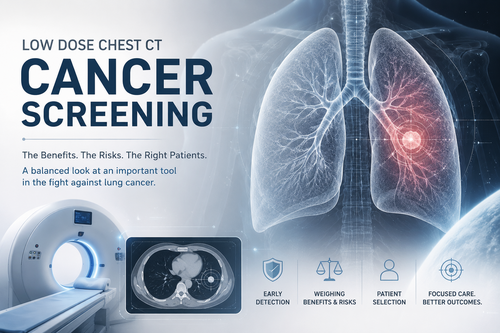
Low-dose CT scans for lung cancer screening are one of the more important advances we have made in preventive medicine over the last two decades. Lung cancer remains the leading cause of cancer death in the United States, largely because it is often discovered late, after symptoms develop and the disease has already spread. The idea behind screening is simple: find lung cancer early, when it is small and potentially curable, before a patient ever develops symptoms.
But like many medical tests, low-dose chest CT screening is not as straightforward as it first sounds. It has real benefits, but it also has real downsides. The challenge is figuring out who is likely to benefit enough that the advantages outweigh the risks.
The current screening recommendations are fairly specific. In general, low-dose CT screening is recommended for adults between the ages of 50 and 80 who have a significant smoking history — usually defined as at least a 20 pack-year history — and who currently smoke or quit within the past 15 years. A “pack-year” means smoking one pack per day for one year. So someone who smoked one pack a day for 20 years, or two packs a day for 10 years, would both meet that threshold.
These recommendations are based on large clinical trials showing that screening high-risk individuals can reduce deaths from lung cancer. The biggest study, the National Lung Screening Trial, showed about a 20% reduction in lung cancer mortality in high-risk smokers who underwent annual low-dose CT scans compared with standard chest X-rays.
That sounds impressive, and it is. But it is also important to understand the actual numbers behind the headlines.
The number needed to treat — or in this case, the number needed to screen — is relatively high. Depending on the study and the population being screened, roughly 300 people need to undergo annual screening over several years to prevent one lung cancer death. That does not mean screening is ineffective. Lung cancer is a devastating disease, and preventing even one death is meaningful. But it does highlight that most screened patients will never personally benefit from the test, while many will still experience its downsides.
One of the biggest issues with CT screening is the extraordinarily high rate of false positives. The lungs are filled with tiny scars, benign nodules, old infections, areas of inflammation, and harmless abnormalities. CT scans are incredibly sensitive, and they detect many things that are not cancer.
In some studies, nearly one in four initial screening CT scans showed something abnormal enough to require follow-up. The overwhelming majority of those findings turned out not to be cancer. Patients often end up getting repeat CT scans, PET scans, biopsies, or referrals to pulmonologists and thoracic surgeons for nodules that ultimately prove benign.
That process can create substantial anxiety. Waiting several months to see if a lung nodule grows is psychologically difficult for many patients. Even when doctors reassure patients that a finding is “probably nothing,” it is human nature to worry about cancer every time the phone rings or another scan approaches.
There are also real physical risks from the follow-up testing itself. Needle biopsies of the lung can cause collapsed lungs or bleeding. Bronchoscopies carry procedural risks. Some patients ultimately undergo surgery to remove suspicious nodules that turn out to be noncancerous. While modern thoracic surgery is safer than it once was, it is still major surgery involving anesthesia, pain, recovery time, and possible complications.
Radiation exposure is another important consideration. The radiation dose from a low-dose CT is much lower than a standard diagnostic chest CT, but it is not zero. Repeated annual scans over many years expose patients to cumulative radiation. Ironically, radiation itself can slightly increase future cancer risk. Estimates vary, but modeling studies suggest that screening thousands of low-risk individuals could potentially cause some cancers from the radiation exposure itself.
This is one of the main reasons we do not screen everyone.
For people at very low risk of lung cancer — for example, lifelong nonsmokers with no major risk factors — the chance of benefiting from screening becomes extremely small, while the risks of false positives, unnecessary procedures, radiation exposure, and anxiety remain. In those patients, screening may ultimately cause more harm than good.
There are exceptions, of course. Some nonsmokers develop lung cancer, particularly women and patients with certain environmental or genetic risk factors. Radon exposure, secondhand smoke, occupational exposures like asbestos, and family history may all contribute to risk. But at the population level, smoking history remains by far the strongest predictor of lung cancer risk, which is why current screening guidelines focus heavily on it.
The key point is that good screening is not simply about finding disease. It is about improving outcomes overall. A screening test only makes sense when the benefits clearly outweigh the harms in the population being tested.
Low-dose CT screening absolutely saves lives in carefully selected high-risk patients. But it is not a perfect test, and it is not a test that should automatically be applied to everyone. Like much of medicine, the art lies in understanding both the power and the limitations of the technology.
But like many medical tests, low-dose chest CT screening is not as straightforward as it first sounds. It has real benefits, but it also has real downsides. The challenge is figuring out who is likely to benefit enough that the advantages outweigh the risks.
The current screening recommendations are fairly specific. In general, low-dose CT screening is recommended for adults between the ages of 50 and 80 who have a significant smoking history — usually defined as at least a 20 pack-year history — and who currently smoke or quit within the past 15 years. A “pack-year” means smoking one pack per day for one year. So someone who smoked one pack a day for 20 years, or two packs a day for 10 years, would both meet that threshold.
These recommendations are based on large clinical trials showing that screening high-risk individuals can reduce deaths from lung cancer. The biggest study, the National Lung Screening Trial, showed about a 20% reduction in lung cancer mortality in high-risk smokers who underwent annual low-dose CT scans compared with standard chest X-rays.
That sounds impressive, and it is. But it is also important to understand the actual numbers behind the headlines.
The number needed to treat — or in this case, the number needed to screen — is relatively high. Depending on the study and the population being screened, roughly 300 people need to undergo annual screening over several years to prevent one lung cancer death. That does not mean screening is ineffective. Lung cancer is a devastating disease, and preventing even one death is meaningful. But it does highlight that most screened patients will never personally benefit from the test, while many will still experience its downsides.
One of the biggest issues with CT screening is the extraordinarily high rate of false positives. The lungs are filled with tiny scars, benign nodules, old infections, areas of inflammation, and harmless abnormalities. CT scans are incredibly sensitive, and they detect many things that are not cancer.
In some studies, nearly one in four initial screening CT scans showed something abnormal enough to require follow-up. The overwhelming majority of those findings turned out not to be cancer. Patients often end up getting repeat CT scans, PET scans, biopsies, or referrals to pulmonologists and thoracic surgeons for nodules that ultimately prove benign.
That process can create substantial anxiety. Waiting several months to see if a lung nodule grows is psychologically difficult for many patients. Even when doctors reassure patients that a finding is “probably nothing,” it is human nature to worry about cancer every time the phone rings or another scan approaches.
There are also real physical risks from the follow-up testing itself. Needle biopsies of the lung can cause collapsed lungs or bleeding. Bronchoscopies carry procedural risks. Some patients ultimately undergo surgery to remove suspicious nodules that turn out to be noncancerous. While modern thoracic surgery is safer than it once was, it is still major surgery involving anesthesia, pain, recovery time, and possible complications.
Radiation exposure is another important consideration. The radiation dose from a low-dose CT is much lower than a standard diagnostic chest CT, but it is not zero. Repeated annual scans over many years expose patients to cumulative radiation. Ironically, radiation itself can slightly increase future cancer risk. Estimates vary, but modeling studies suggest that screening thousands of low-risk individuals could potentially cause some cancers from the radiation exposure itself.
This is one of the main reasons we do not screen everyone.
For people at very low risk of lung cancer — for example, lifelong nonsmokers with no major risk factors — the chance of benefiting from screening becomes extremely small, while the risks of false positives, unnecessary procedures, radiation exposure, and anxiety remain. In those patients, screening may ultimately cause more harm than good.
There are exceptions, of course. Some nonsmokers develop lung cancer, particularly women and patients with certain environmental or genetic risk factors. Radon exposure, secondhand smoke, occupational exposures like asbestos, and family history may all contribute to risk. But at the population level, smoking history remains by far the strongest predictor of lung cancer risk, which is why current screening guidelines focus heavily on it.
The key point is that good screening is not simply about finding disease. It is about improving outcomes overall. A screening test only makes sense when the benefits clearly outweigh the harms in the population being tested.
Low-dose CT screening absolutely saves lives in carefully selected high-risk patients. But it is not a perfect test, and it is not a test that should automatically be applied to everyone. Like much of medicine, the art lies in understanding both the power and the limitations of the technology.
Recent
Measels: Who needs to update their vaccine?
May 12th, 2026
Lung Cancer - Who should get screened (Update)
May 12th, 2026
Are You Really Allergic to Penicillin? The Truth Might Surprise You
January 19th, 2025
Understanding Homeopathy: A Critical Look
October 25th, 2024
HPV Vaccines - Fact and Fiction
July 5th, 2024
Archive
2024
May
Ozempic - Obesity cure or panacea?GMO's (Genetically Modified Organisms) - Are they truly "Frankenfoods" or our best hope for feeding a hungry world?The Drip Dilemma: Why Healthy People Should Steer Clear of IV TherapyLung Cancer Screening - Is it time to get a CT scan?The Whole Truth Behind Whole Body MRI Scans – Overhyped, Overpriced, and Overrated!Understanding Sinus Infections: Beyond the Common ColdAbdominal Aortic Aneurysms: What You Need to Know
June
2014
March
May
2013
July
August
October
November
Omega 3's (Fish Oil and Flax Seed Oil) who should take them?How do you save a life ? - Just swab your cheekNew Cholesterol Guidelines - What's changed and what does it mean for you?Antibiotics and Probiotics- Why you shouldn't take either without a good reasonPreventing Heart Disease with almonds- Is this study Nuts?